
Resin 3D Printing for Product Prototypes: When Is It Better Than CNC or Molding?

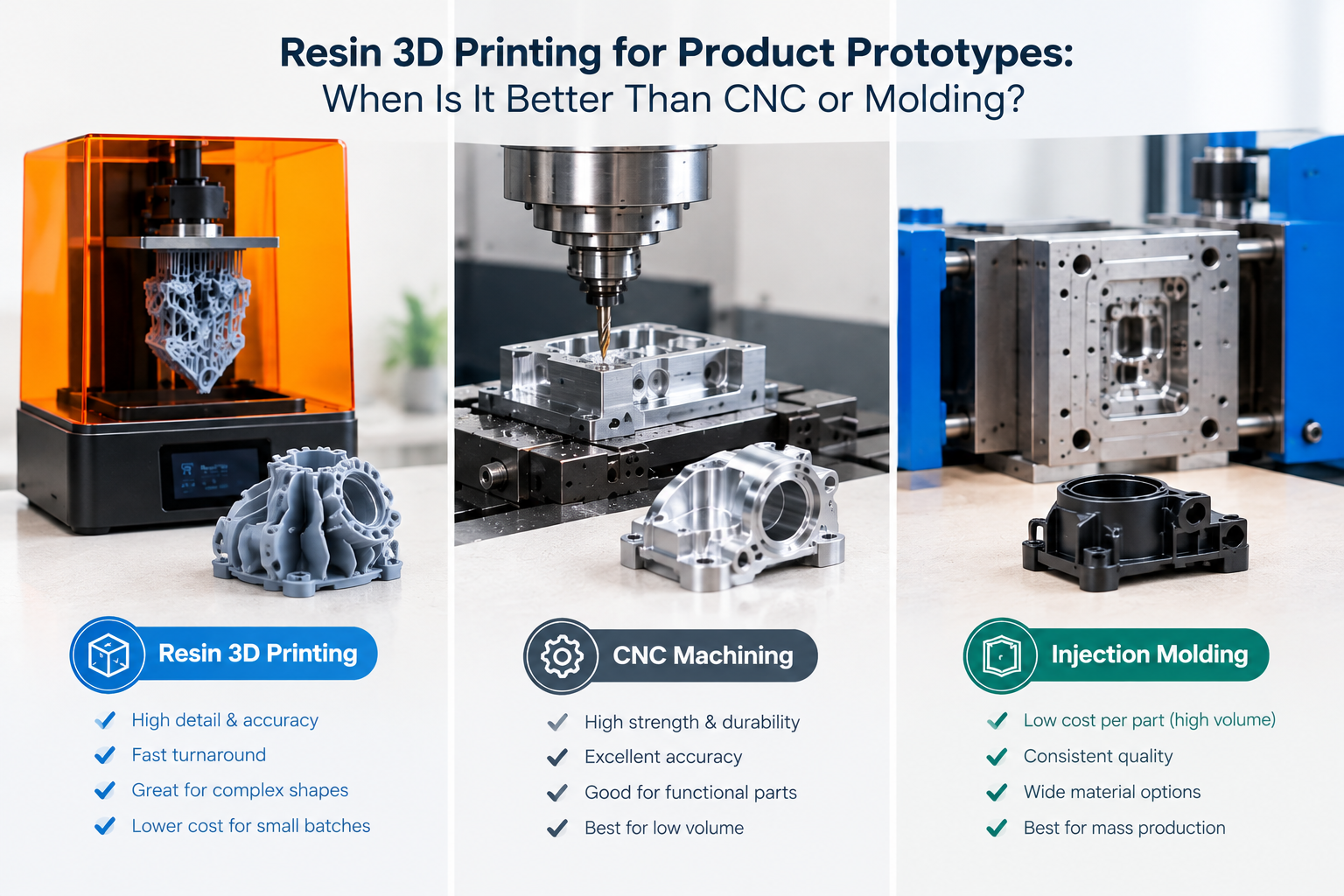
Every new product starts as an idea, and ideas need to be held, tested, and shown to other people. That is what a prototype is for.
For years, getting a prototype meant sending drawings to a CNC shop or paying for a mold. Both work, but both can be slow and expensive when you are still changing the design every week.
Resin 3D printing has changed that. It lets you turn a CAD file into a smooth, detailed part in a day, often at your own desk. But it is not the right choice for every situation.
In this guide, we compare resin 3D printing vs CNC machining vs molding for product prototypes. You will learn where each method shines, where it falls short, and how to choose the right one for your project.
What Is Resin 3D Printing?
Resin 3D printing, also called SLA, MSLA, or LCD printing, builds a part by curing liquid photopolymer resin with UV light, one thin layer at a time.
Because the layers are very thin, resin prints have:
- Smooth surfaces
- Sharp edges and fine details
- Good accuracy on small parts
- Very little visible layer lines compared to filament printers
That is why resin printing is popular for product design, dental models, jewelry, miniatures, and engineering prototypes. If you want to understand the technology better, our guide on why resin 3D prints fail also explains how the process works in practice.
A Quick Look at the Alternatives
CNC Machining
CNC machining removes material from a solid block, such as aluminum, plastic, or brass, using cutting tools controlled by a computer. It is a subtractive process, the opposite of 3D printing.
It is known for tight tolerances, strong parts, and real production materials.
Molding
Molding means shaping material by pouring or injecting it into a cavity. For prototypes, this usually means one of two things:
- Silicone or urethane casting, where a master pattern is used to make a soft mold and then a small batch of copies.
- Injection molding, where molten plastic is forced into a metal mold. It is the standard for mass production, but the mold itself is expensive and takes time to make.
When Resin 3D Printing Is Better
Here are the situations where resin printing usually beats the alternatives.
1. When You Need Speed
Speed is the biggest advantage. You can finish a design in the evening, print overnight, and hold the part the next morning.
A CNC job usually involves quoting, programming, setup, and machining. A mold can take weeks. When your design changes often, those delays add up quickly.
2. When Your Design Is Still Changing
Early prototypes are meant to be wrong. You will find problems, change dimensions, and try new ideas.
With resin printing, changing the design costs almost nothing extra. You edit the file and print again. With molds, even a small change can mean a new tool, which is both costly and slow.
3. When You Need Fine Detail
Resin printers are very good at small features, such as thin walls, logos, text, textures, and small snap-fits.
That makes them ideal for visual prototypes, such as consumer products, cosmetic packaging, wearable devices, and anything that needs to look finished. If detail matters to you, it helps to understand how resolution affects the result. Our comparison of 8K vs 16K resin 3D printers explains this in simple terms.
4. When the Shape Is Complex
CNC machines are limited by tool access. A cutting tool cannot reach inside a closed cavity or machine an undercut easily.
Resin printing builds layer by layer, so internal channels, organic curves, and complex shapes are no problem. Often, a part that would need to be split into several machined pieces can be printed as one.
5. When You Need a Small Number of Parts
For one to a few dozen parts, resin printing is usually the cheapest route. There are no mold costs, and setup is minimal.
6. When You Want to Test Fit and Assembly
You can print a part, check how it fits with other components, find the mistake, and print the corrected version the same day. This is very valuable for enclosures, brackets, housings, and mechanical assemblies.
7. When You Need Presentation Models
A smooth, detailed resin print can be sanded, primed, and painted to look close to a finished product. This is great for investor meetings, client presentations, photography, and trade show displays.
8. When You Want to Keep Things In-House
Owning a resin printer means your designs stay private and your schedule stays in your own hands. For many small businesses and startups, this alone is a good reason to bring prototyping in-house.
When CNC Machining Is Better
Resin printing is not always the answer. CNC is the better choice when:
- You need true production materials. If the prototype must be made from aluminum, stainless steel, or a specific engineering plastic, CNC can use the same material as the final product.
- You need very tight tolerances. CNC can hold very precise dimensions, which matters for bearings, threads, and moving parts.
- The part must carry heavy loads. Metal machined parts are far stronger than any printed resin.
- The part needs to survive heat or harsh conditions. Standard resins can soften, warp, or become brittle under high temperatures or sunlight over time.
- You need a large part. Resin printers have limited build volume. Large parts are often easier to machine.
A good rule is this: if the test depends on the material, use CNC. If it depends on the shape, look, or fit, use resin.
When Molding Is Better
Molding makes sense when:
- You need many identical parts. Once a mold is made, the cost per part drops dramatically.
- You need the final production material and finish. Injection molding produces parts that behave like the finished product.
- The design is final. Molds are an investment, so you want to be confident in your design before making one.
- You are testing manufacturing, not just design. Molding shows how the part will behave in real production, including shrinkage and surface finish.
A Hybrid Approach: Resin Printing and Silicone Molding
Many teams do not choose one method. They combine them.
A popular workflow looks like this:
- Print a highly detailed master pattern in resin.
- Sand and finish the master until the surface is perfect.
- Make a silicone mold from the master.
- Cast a small batch of copies in urethane or similar materials.
This gives you the detail of resin printing with the material options of casting. It is a great middle step between a single prototype and full injection molding, especially for small production runs of 10 to 50 parts.
Side-by-Side Comparison
| Factor | Resin 3D Printing | CNC Machining | Molding |
|---|---|---|---|
| Speed for first part | Fast (hours to a day) | Moderate (days) | Slow (days to weeks) |
| Upfront cost | Low | Moderate | High for injection molds |
| Cost for one part | Low | Moderate to high | Very high |
| Cost for many parts | Moderate | Moderate to high | Very low |
| Detail and surface finish | Excellent | Good to excellent | Excellent |
| Complex shapes | Excellent | Limited by tool access | Limited by mold design |
| Material variety | Resin types only | Wide, including metals | Wide |
| Strength and heat resistance | Moderate | Excellent | Excellent |
| Easy to change design | Very easy | Easy | Difficult and costly |
These are general comparisons. Actual results depend on the printer, the material, and the part.
How to Decide: A simple Checklist
Ask yourself these questions before choosing a method.
1. What am I testing: look, fit, or function?
- Look or fit: resin printing
- Function with real material properties: CNC or molding
2. How many parts do I need?
- 1 to 20: resin printing
- 10 to 50: resin master with silicone casting
- Hundreds or more: molding
3. How final is my design?
- Still changing: resin printing
- Almost final: CNC or soft tooling
- Locked: injection molding
4. What is my deadline?
- Within days: resin printing
- A few weeks: CNC or casting
- Months: molding is possible
5. What is my budget?
- Tight: start with resin printing
- Flexible: choose by technical need
Choosing the Right Resin for Prototypes
Not all resins are the same, and picking the right one matters.
- Standard resin: Great for visual models and general prototypes with fine detail.
- Tough or ABS-like resin: Better for parts that need to flex a little or survive handling and snap-fits.
- Flexible resin: Useful for gaskets, grips, and soft-touch parts.
- High-temperature resin: Suitable for parts that must handle heat.
- Castable resin: Made for casting patterns in jewelry and small metal parts.
- Dental resins: Designed for dental models and appliances.
Always check the resin’s data sheet for details like strength, flexibility, and temperature limits. If you want to explore options for your workshop, take a look at our resin 3D printers and materials.
Tips to Get Better Resin Prototypes
A few simple habits make a big difference:
- Design for the process. Keep wall thickness consistent and avoid very thin unsupported features.
- Orient parts carefully. The direction you print in affects strength, surface finish, and supports.
- Add small tolerances. For parts that need to fit together, leave a small gap. Print a test piece first.
- Wash and cure properly. Under-curing leaves parts weak and sticky, while over-curing can make them brittle.
- Finish when needed. Light sanding, priming, and painting can make a print look like a finished product.
- Keep your printer in good shape. A clean vat, healthy release film, and well-leveled plate prevent most failures.
Common Mistakes to Avoid
- Using a resin print to test a part that needs real metal strength
- Making a mold before the design is stable
- Ignoring heat and sunlight limits of the resin
- Skipping the post-curing step
- Printing a fit-critical part without a tolerance test
- Choosing a method based only on price instead of what you need to learn
FAQ
Is resin 3D printing good for product prototypes?
Yes. It is one of the best options for fast, detailed prototypes, especially when you need a smooth surface, fine features, or quick design changes.
Is resin printing cheaper than CNC machining?
For small numbers of parts and complex shapes, usually yes. For simple shapes in metal or when you need strong parts, CNC can be the better value.
Can resin prints replace injection molded parts?
For testing and small batches, they can come close. For final production parts that need long-term strength, heat resistance, and low cost per part, molding is still the better choice.
How accurate is resin 3D printing?
Resin printers are very accurate for small parts, though results depend on the printer, calibration, resin, and part shape. CNC machining can usually hold tighter tolerances.
Are resin prototypes strong enough?
They are strong enough for fit tests, display models, and light functional testing. For heavy loads, high heat, or long-term outdoor use, choose a stronger process or material.
Can I paint a resin prototype?
Yes. Resin prints take sanding, primer, and paint very well, which is why they are popular for presentation models.
Conclusion
There is no single best way to build a prototype. The right choice depends on what you are trying to learn.
Resin 3D printing is better when you need speed, fine detail, complex shapes, quick design changes, and small quantities. CNC machining is better when you need real material strength and tight tolerances. Molding is better when your design is final and you need many identical parts.
For many teams, the smartest path is to start with resin printing, refine the design quickly, and move to CNC or molding only when the design is ready. That saves time, reduces risk, and keeps costs under control.
If you are ready to bring prototyping in-house, explore our range of resin printers, resins, and accessories at MCast 3D.