
Personalization at Scale: How Resin Printing Meets Customer Demand

Customers increasingly want products that feel personal. In jewelry, that can mean a custom name, a unique pattern, a different ring size, or a design created specifically for one person.
For jewelry businesses, meeting this demand can be challenging when every order requires manual changes and separate production steps.
Resin 3D printing offers a practical way to handle customized designs while keeping production organized. Instead of treating every custom order as a completely different manufacturing process, businesses can move much of the work into a digital workflow.
With the right resin 3D printer for jewelry, customization can become part of a repeatable production system.
Why Personalized Jewelry Is Growing
Personalized jewelry has become an important part of modern jewelry businesses.
Customers may request:
- Initials and names
- Custom ring sizes
- Engraved messages
- Unique patterns
- Personalized pendants
- Custom charms
- One-of-a-kind decorative details
- Designs based on customer sketches
Traditional production methods can make these changes time-consuming.
A digital workflow makes customization easier because the design can be edited before anything is physically produced.
This is where jewelry 3D printing becomes useful.
From Customer Request to Digital Design
The first step is turning a customer’s idea into a workable 3D model.
A jewelry designer can create or modify the design using CAD software. Changes such as ring size, engraving, lettering, or decorative elements can be made digitally.
Once the design is approved, the model can move into the slicing stage.
This creates a simple workflow:
Customer request → CAD design → Slicing → Resin printing → Post-processing → Casting or finishing
The biggest advantage is flexibility.
If a customer wants another size or a small design change, the digital model can be adjusted without rebuilding the entire production process.
Why Resin Printing Works Well for Custom Designs
Jewelry often contains details that are difficult to reproduce with less precise manufacturing methods.
Small letters, sharp edges, thin sections, decorative textures, and intricate patterns all require accurate printing.
Resin printing is particularly useful for these applications because it can produce fine details and smooth surfaces.
This makes a resin printer for jewelry making useful not only for prototypes, but also for customized production workflows.
Personalization Without Slowing Down Production
One concern with custom orders is production time.
If every personalized piece requires a completely separate workflow, increasing order volume can quickly become difficult.
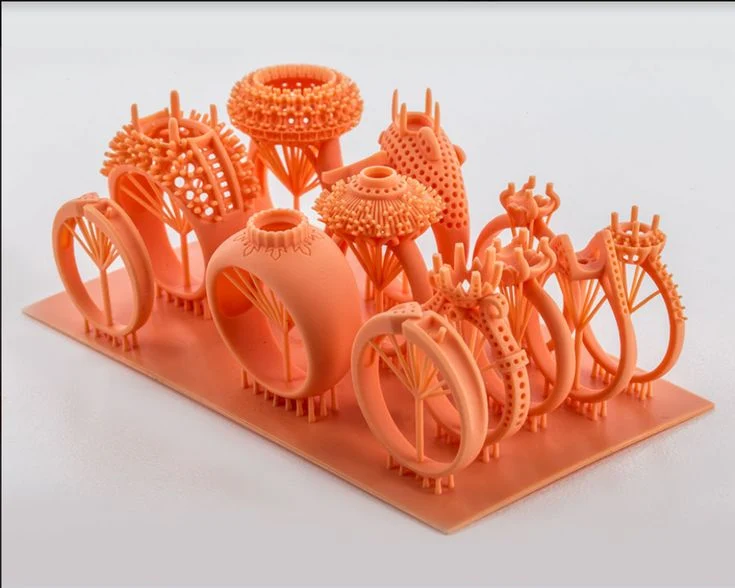
Resin printing helps by allowing multiple designs to be arranged on the same build platform.
For example, a jewelry business could prepare several customer orders together:
- Customer A’s customized ring
- Customer B’s pendant
- Customer C’s earrings
- Customer D’s engraved design
Instead of printing each model individually, suitable models can be arranged together in one print job.
This makes 3D printing for jewelry production more flexible when handling small batches of different designs.
Choosing the Right Printer for Growing Demand
The printer becomes increasingly important as customization volume grows.
For smaller batches and highly detailed individual designs, the Nova3D GEM3 provides a compact professional setup. Its high-resolution printing system is designed for detailed models and precision-focused applications.
For businesses handling more customized pieces per print, the Nova3D GEM3 Max provides a larger 211 × 118 × 120 mm build volume.
Its 15120 × 6230 resolution and 14 × 19 μm pixel size are designed for detailed jewelry models. The larger platform also provides more room for arranging multiple pieces in a single print.
The choice between them depends on production volume, available workspace, and the size and number of models being produced.
Castable Resin for Personalized Jewelry
When customized jewelry is intended for casting, the resin must match the production process.
A castable resin is designed to produce patterns that can be processed through an investment casting workflow.
MCast currently offers a jewellery castable resin range, including Retroflow Yellow Green Castable Resin in 250 ml, 500 ml, and 1000 ml options. These products are listed in the current MCast jewellery castable resin category.
The important point is that resin selection should be based on the intended application rather than simply choosing a material because it produces a good-looking print.
For casting, the burnout and investment process are just as important as print quality.
Personalization Becomes Easier With Digital Workflows
One of the biggest advantages of resin 3D printing for jewelry is that customization happens digitally.
Consider a customer ordering a ring.
The business can:
- Create the initial CAD design.
- Adjust the ring size.
- Add the requested name or pattern.
- Send the design for customer approval.
- Prepare the final model in the slicer.
- Print the pattern using suitable castable resin.
- Post-process the print.
- Continue with the chosen casting workflow.
If the customer changes the engraving before production, the digital file can be updated.
There is no need to remake a physical master model.
Reducing the Cost of Small-Batch Customization
Customization can be difficult when production depends heavily on molds, tooling, or manual model making.
Every design variation may require additional preparation.
Digital resin printing reduces this dependency for suitable applications.
A jewelry business can maintain a digital library of approved designs and create variations when customers request them.
For example, the same base ring design can have:
- Different sizes
- Different names
- Different patterns
- Different stone arrangements
- Different surface details
This approach makes custom jewelry 3D printing more practical for businesses that receive many small orders.
Quality Still Matters
Scaling personalization does not mean sacrificing quality.
Small mistakes can become expensive when they affect multiple customer orders.
Before printing, businesses should check:
- Wall thickness
- Minimum feature size
- Engraving depth
- Model orientation
- Support placement
- Drainage where required
- Overall dimensions
- Resin compatibility
- Casting requirements
After printing, the model should also be inspected before it moves to the next stage.
A repeatable quality-control process helps ensure that personalization remains consistent as order volume increases.
Building a Repeatable Jewelry Printing Workflow
The real value of resin printing is not simply producing one customized piece.
It is creating a workflow that can handle many different designs without becoming difficult to manage.
A jewelry business can standardize:
- CAD templates
- Customer approval stages
- File naming
- Slicing profiles
- Printer settings
- Support strategies
- Washing and curing procedures
- Quality checks
- Casting preparation
Once these steps become repeatable, customized orders can move through production more efficiently.
When to Use the GEM3 and GEM3 Max
Both the Nova3D GEM3 and GEM3 Max are suitable for detailed resin printing applications, but their build areas make them useful in different situations.
Nova3D GEM3
The GEM3 is suited to businesses that need detailed printing in a relatively compact machine.
Its 154 × 87 × 120 mm build volume works well for individual jewelry models and smaller batches. Its 17 × 17 μm pixel size supports fine surface and design details.
Nova3D GEM3 Max
The GEM3 Max offers a larger 211 × 118 × 120 mm build area.
That additional space can be useful when a business needs to arrange more customized pieces in the same print job.
Its 14 × 19 μm pixel size and 15120 × 6230 resolution also make it suitable for detailed jewelry models.
The Future of Custom Jewelry Production
Personalization is changing how jewelry businesses approach production.
Customers no longer have to choose only from fixed designs. Digital modeling allows businesses to offer variations without completely changing their manufacturing process.
Resin 3D printing supports this shift by connecting digital design with physical production.
The result is a workflow where a unique customer request can move from an idea to a detailed physical model with fewer traditional manufacturing constraints.
For jewelry businesses, the goal is not simply to print more pieces.
It is to make custom jewelry production flexible enough to handle more individual orders while maintaining consistent quality.
Conclusion
Personalization and small-batch production are becoming increasingly important in jewelry.
Resin 3D printing provides a practical way to connect customized CAD designs with detailed physical models. With a suitable jewelry 3D printer, businesses can produce different designs, sizes, and patterns without rebuilding their entire production workflow for every customer.
Printers such as the Nova3D GEM3 and GEM3 Max provide high-resolution platforms for detailed jewelry applications, while suitable castable resin can connect the printed pattern with a casting workflow.
The key is to treat personalization as part of a repeatable digital production process. When design, printing, post-processing, and quality control work together, custom orders can become a manageable part of everyday jewelry production.